The Kansas Town Where Everyone Kept Falling Asleep — Standing Up, Mid-Sentence, Mid-Life
Nobody Saw It Coming — Literally
Picture this: you're sitting at your kitchen table, fork in hand, halfway through a sentence about the weather, and then — nothing. You don't feel tired. You don't feel sick. You simply stop existing for the next three days while your family watches in terror and your breakfast gets cold.
That's not a horror movie premise. That's what actually started happening to real people in a small Kansas farming community during the early 1980s, in one of the most baffling and underreported medical episodes in American history.
The town — a tight-knit agricultural community where everybody knew everybody and news traveled fast — began noticing something deeply wrong when a handful of residents started dropping into what could only be described as comas. Not the dramatic, movie-style kind. These were quiet, inexplicable collapses into sleep so deep that no amount of shaking, shouting, or bright lights could break through. Victims simply... went away for a while. Then they came back, groggy and confused, with no memory of the lost days.
At first, neighbors chalked it up to exhaustion. Farming is brutal work. But when a woman fell asleep mid-conversation at the post office and didn't wake up for 36 hours, the explanation of "too much field work" started wearing thin.
The Town That Couldn't Stay Awake
Within months, the episodes multiplied. Dozens of residents were affected. Young, old, male, female — the sleeping sickness showed no preference. One man reportedly fell asleep while walking to his mailbox and was found by his wife still standing, propped against the fence post like a scarecrow. A teenager slumped over her school lunch tray and had to be carried home by the principal.
Local doctors were baffled. They ran every test they could think of — blood panels, neurological screenings, cardiac workups — and found nothing conclusive. The patients weren't sick in any conventional sense. They were just... asleep. Profoundly, stubbornly, impossibly asleep.
Word spread beyond the county line, and the media came calling. News vans parked along the main road. Reporters filed dispatches about the "Sleeping Town of Kansas." The community, already shaken, now had cameras pointed at its most intimate suffering.
Federal health investigators arrived not long after. The Centers for Disease Control sent a team. Epidemiologists mapped the cases, interviewed every affected family, and sampled water, soil, and air. The town held its breath — figuratively, at least — waiting for answers.
 Photo: Centers for Disease Control, via cdn.abcotvs.com
The Investigation That Went Nowhere Fast
For months, investigators chased dead ends. Theories came and went like Kansas weather. A viral encephalitis? Ruled out — no consistent viral markers. A toxin in the water supply? Tested and cleared. A shared food source? Too many variables, no common thread.
One researcher floated the idea of mass psychosomatic illness — the medical equivalent of blaming the victim — and was promptly dismissed when a man who hadn't heard about any of the other cases fell asleep in front of investigators during an interview. That pretty much ended that theory.
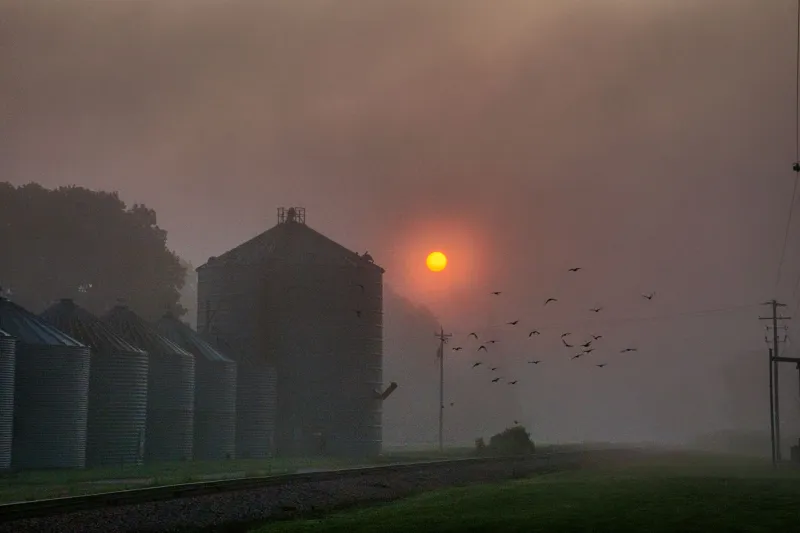
The town's wells were tested repeatedly. The soil around the oldest farmsteads was analyzed. Air samples were collected from basements, barns, and grain silos. Nothing jumped out. The community was running out of patience, the investigators were running out of ideas, and the sleeping kept happening.
The Answer That Was There All Along
The breakthrough came not from a laboratory but from a conversation. A retired agricultural extension agent, reviewing the case files almost by accident, noticed something the medical teams had overlooked: the geographic clustering of cases wasn't random. Every affected household sat within a specific radius of a cluster of older grain storage facilities — facilities that had been in continuous use since the 1940s.
Further investigation revealed that those storage structures had been treated for decades with a particular pesticide compound, one that had been phased out of commercial use but never fully removed from the physical infrastructure. Over time, as the treated wood and concrete aged and degraded, the compound had been releasing low-level vapors into the surrounding environment — not enough to trigger standard toxicology screens, but more than enough, under the right atmospheric conditions, to affect the central nervous systems of people with prolonged exposure.
The specific compound interacted with a naturally occurring mold present in the region's soil, producing a secondary metabolite that essentially functioned as a powerful sedative when inhaled in accumulated doses. It was a chemical chain reaction hiding inside forty-year-old farm infrastructure, invisible to every test that wasn't specifically looking for it.
Once identified, the fix was relatively straightforward — remediation of the storage facilities, improved ventilation standards, and monitoring of affected residents. The sleeping episodes stopped.
Why This Story Still Matters
The Kansas sleeping town never became the cultural touchstone it probably deserved to be. It was overshadowed by bigger news cycles, its resolution tucked into agricultural safety bulletins rather than front-page headlines. But the story is a remarkable reminder of how thin the line can be between "unexplained" and "hiding in plain sight."
The residents affected didn't have a dramatic disease. They had a slow-motion chemical accident built into the bones of their community's infrastructure, invisible for decades until it wasn't.
And somewhere in a Kansas county records office, there are case files describing a man found asleep against a fence post on a Tuesday afternoon in 1983, who woke up two days later and asked if anyone had checked on his cattle.
The cattle were fine. The man was fine. But the story is the kind of thing that makes you look twice at your own walls and wonder what else might be hiding in plain sight.