This Man's Entire Federal Career Was Listening to Cheese
This Man's Entire Federal Career Was Listening to Cheese
Before you dismiss this as a bit from a late-night comedy show, know that it is fully, documentably real: for much of the twentieth century, the United States government employed trained specialists whose job included pressing an ear against a wheel of cheese and listening. Not metaphorically. Literally listening. And the federal dairy industry hung on what they heard.
This is the strange, surprisingly rigorous, and almost entirely forgotten world of the USDA cheese grader — one of the more unusual career paths in American bureaucratic history.
Why the Government Got Into the Cheese Business
By the early twentieth century, American dairy production had exploded. Wisconsin alone was producing staggering quantities of cheddar, colby, and swiss, and the industry had a consistency problem. Without standardized quality benchmarks, consumers had no reliable way to know whether the block of cheddar they were buying was genuinely good or a wheel of mediocre dairy that someone had optimistically labeled "aged."
The USDA stepped in with a formal grading system. Under the program, federal inspectors would evaluate cheese on a detailed point-based scale — assessing flavor, body, texture, color, and finish — and assign official grade designations that manufacturers could use on their packaging. Grade AA meant something specific. Grade B meant something else. And the whole system depended on the judgment of trained human graders whose senses had been calibrated through years of hands-on experience.
What made the job genuinely strange was what "hands-on" actually meant in practice.
The Art of Listening to a Rind
A cheese grader's toolkit was deceptively simple: a small metal trier for extracting core samples, a scoring sheet, and — crucially — their own sensory apparatus. Smell was essential. A trained grader could detect the early signs of improper fermentation, off-flavors, or contamination from a whiff of a freshly pulled plug that would be completely undetectable to an untrained nose.
But the listening part is what tends to stop people cold when they first hear about it.
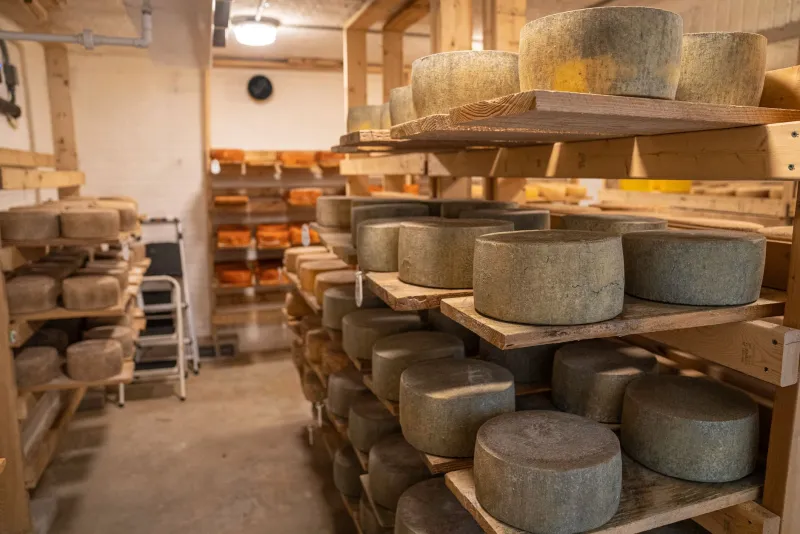
For certain varieties — particularly hard cheeses like aged cheddar and parmesan-style wheels — tapping and listening to the rind was a legitimate diagnostic technique. A grader would knock on the surface of the wheel and press an ear close, interpreting the resonance. A dull, flat thud could indicate improper gas formation inside the paste — a defect called "openness" that affected both texture and flavor. A clean, consistent ring suggested a properly formed wheel. The sound of the cheese, quite literally, told the grader something about what was happening inside.
This wasn't folk wisdom or dairy mysticism. It was a trained sensory skill that took years to develop, and the USDA took it seriously enough to build it into their official grading protocols.
A Career With Real Consequences
Here's what makes this more than just a quirky historical footnote: these graders had genuine power over the American dairy industry.
A federal grade designation wasn't just a marketing label. It determined pricing tiers, export eligibility, and whether a dairy operation's product could be sold to government buyers — including school lunch programs, military commissaries, and federal institutions. A grader who downgraded a batch from AA to B wasn't just making a technical notation. He was potentially costing a dairy farmer thousands of dollars in a single afternoon.
Wisconsin, which certified its own state-level cheese graders in parallel with the federal system, treated the grading exam with genuine seriousness. Candidates were tested on their ability to identify specific flavor defects by name — "barny," "fruity," "yeasty," "rancid" — and to correctly score sample wheels against a standardized rubric. Failing the exam meant you didn't grade cheese. Passing it meant you had one of the more unusual skill sets in American professional life.
The Graders Nobody Talked About
What's striking, in retrospect, is how little public attention this world ever received. These were federal employees doing genuinely specialized work that touched millions of American households — because the cheese in your grocery store, the slice on your school cafeteria tray, the block in your holiday cheese board, all of it moved through a system that depended on someone's trained nose and calibrated ear.
And yet the cheese grader never became a cultural figure. There's no Hollywood version of this story. No one made a documentary about the man who could identify "gas pocket formation" in a wheel of swiss by the sound it made when he tapped it with two fingers.
Maybe that's the strangest part of all. For decades, a small group of federally employed humans walked into dairy facilities across the Midwest, pressed their ears to wheels of aging cheese, and rendered judgments that quietly shaped the American food supply. They were serious professionals doing a job that sounds completely made up.
And they were very, very good at it.