The Most Unlikely Military Unit in American History
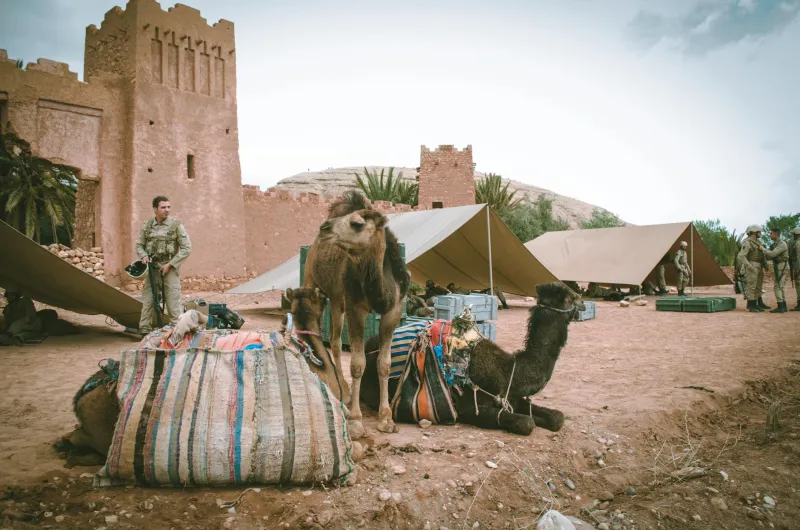
Picture this: It's 1857, and you're a settler in the Arizona Territory when you spot a caravan approaching through the desert heat. But instead of horses or mules, the pack train consists of towering, single-humped camels led by a man in flowing Middle Eastern robes. You're not hallucinating from the desert sun — you're witnessing one of the U.S. military's strangest experiments in action.
The U.S. Camel Corps sounds like something out of a fever dream, but it was a legitimate federal program that nearly transformed how America conquered the West. And for a brief, shining moment, it actually worked.
When Manifest Destiny Met Middle Eastern Innovation
The story begins with Jefferson Davis — yes, the future Confederate president — serving as Secretary of War under Franklin Pierce. In the 1850s, the U.S. was rapidly expanding westward, but the harsh desert terrain of the Southwest was proving nearly impossible for traditional pack animals. Horses and mules struggled with the heat, required massive amounts of water, and frequently died on long hauls across waterless stretches.
Davis had a wild idea: Why not use the animals that had been thriving in similar conditions for thousands of years? In 1855, Congress allocated $30,000 (roughly $1 million today) for the "Camel Military Corps" — an experimental program to import camels from the Ottoman Empire and test their effectiveness in American deserts.
Major Henry Wayne and Lieutenant David Porter sailed to the Mediterranean, where they purchased 33 camels in Egypt and Turkey. The animals were loaded onto the USS Supply, along with several Middle Eastern handlers who knew how to manage them. The most famous of these handlers was Hadji Ali, whom American soldiers couldn't pronounce correctly and nicknamed "Hi Jolly."
The Camel Corps Actually Worked
What happened next surprised everyone, including the skeptical Army officers who thought the whole thing was a boondoggle. The camels were incredible.
They could carry 600-pound loads — twice what a mule could manage. They traveled 30-40 miles per day across terrain that would kill horses. Most importantly, they could go five to eight days without water, making them perfect for the waterless stretches between settlements.
The first major test came in 1857, when Lieutenant Edward Beale led a camel expedition to survey a wagon road from Fort Defiance, New Mexico, to the Colorado River. The mission was a spectacular success. While traditional pack animals struggled and died, the camels thrived. Beale wrote glowing reports about their performance, noting that they not only survived the journey but actually gained weight.
The camels handled rocky terrain better than horses, required less food, and showed remarkable endurance. They could eat desert vegetation that other animals wouldn't touch, including thorny plants that would injure horses and mules. Some officers began seriously discussing expanding the program and importing hundreds more camels.
Hi Jolly and the Cultural Collision
The program's success created its own problems. American soldiers and civilians had no idea how to handle camels, which had different temperaments and needs than familiar livestock. The animals were intelligent but stubborn, and their alien appearance terrified horses and mules, causing chaos in military camps.
Hi Jolly became a legendary figure, part animal handler, part cultural ambassador. He taught American soldiers how to load and manage the camels, but the cultural gap was enormous. The camels responded to Arabic commands, required different care routines, and behaved in ways that baffled American handlers.
More problematically, the camels smelled terrible to American noses, made disturbing noises, and had a habit of spitting at anyone who annoyed them. Soldiers complained constantly about their new four-legged comrades.
When War Killed the Camel Corps
Just as the Camel Corps was proving its worth, history intervened. Jefferson Davis resigned as Secretary of War in 1857 and later became president of the Confederacy. The Civil War consumed all military attention and resources, leaving no room for experimental desert logistics.
The camels were scattered to various Army posts, where they languished without proper care or purpose. Some were sold to circuses and private owners. Others were simply turned loose in the desert to fend for themselves.
The Wild West's Strangest Residents
This is where the story gets truly bizarre. For decades after the program ended, reports of wild camels surfaced throughout the Southwest. These feral descendants of the Army's experiment wandered the deserts of Arizona, Nevada, and Texas, occasionally startling travelers and becoming the stuff of local legend.
The most famous was the "Red Ghost," a massive camel that terrorized Arizona Territory in the 1880s. Witnesses claimed it carried the skeletal remains of a rider strapped to its back — possibly a cavalry soldier who had died during the original experiments. The Red Ghost was finally shot and killed in 1893, but other wild camels were spotted well into the 20th century.
Hi Jolly settled in Arizona, became a U.S. citizen, and worked various jobs until his death in 1902. The state erected a monument to him in Quartzsite, Arizona, complete with a metal camel on top — one of the few official acknowledgments of America's brief experiment with desert warfare, Middle Eastern style.
The Road Not Taken
Military historians still debate what might have happened if the Civil War hadn't derailed the Camel Corps. The animals had proven their worth in exactly the conditions where the Army most needed reliable transportation. If the program had continued, camel trains might have become as common in the American West as covered wagons.
Instead, the U.S. Camel Corps remains one of history's most successful failed experiments — a reminder that sometimes the most ridiculous-sounding ideas are exactly what the situation requires. The American West was won by horses, mules, and railroads, but for a brief moment, it almost belonged to the camel.