When Government Accidentally Deletes Itself
What happens when an entire county government goes bankrupt? Not the kind of budget crisis that makes headlines today, but actually, literally broke — as in, no money to pay the sheriff, no funds to keep the courthouse open, and technically no legal authority to collect taxes anymore.
Most people assume this is impossible. Counties don't just disappear, right? Tell that to the residents of Fentress County, Tennessee, who watched their local government essentially evaporate in 1896 due to a perfect storm of clerical incompetence, mathematical errors, and spectacularly bad timing.
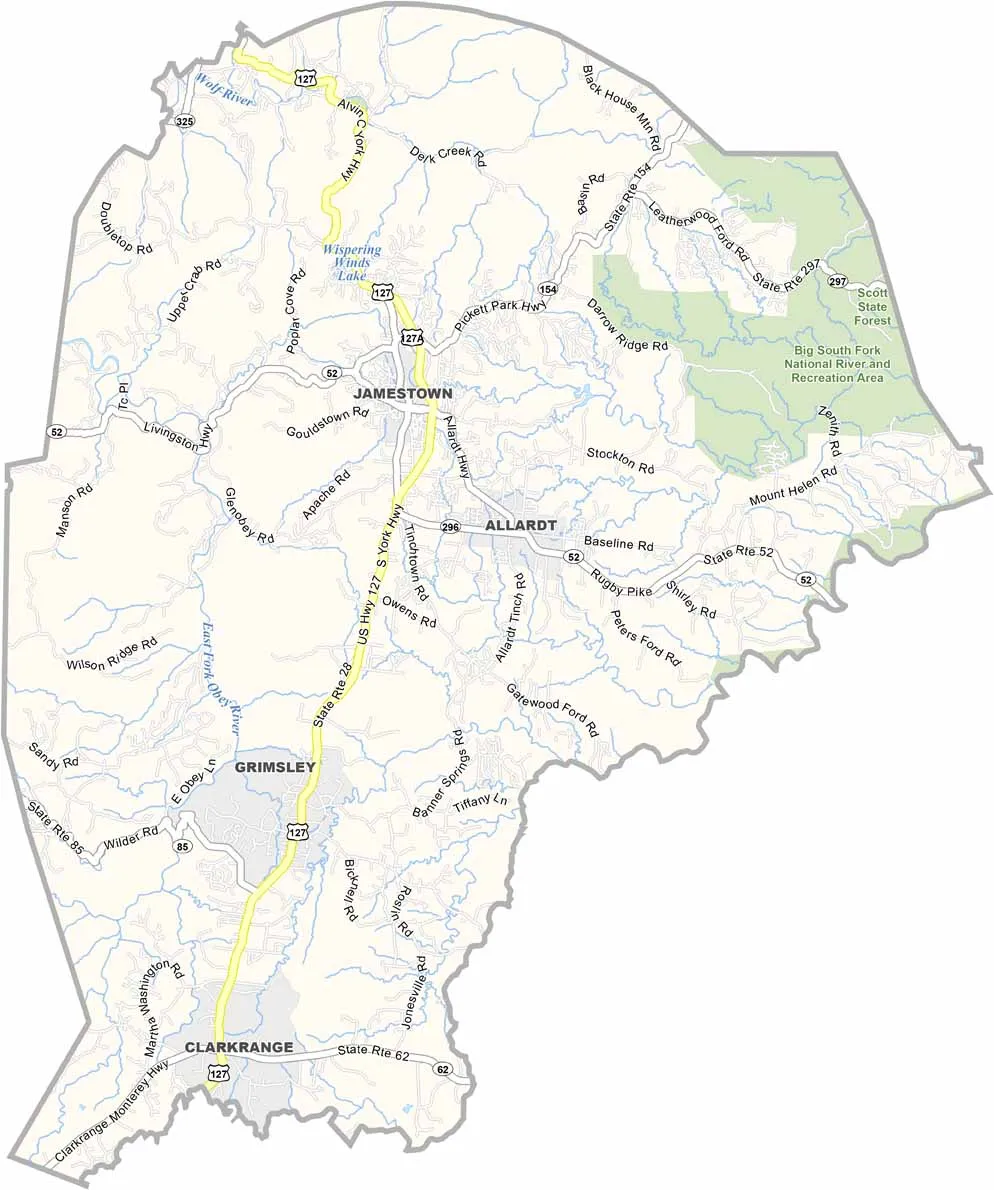 Photo: Fentress County, Tennessee, via uscountymaps.com
The Domino Effect Begins
The trouble started innocently enough with what should have been routine paperwork. In 1895, Fentress County's tax assessor — let's call him optimistically inexperienced — made a series of calculation errors when determining property values. Instead of the modest increases typical for rural Tennessee, he accidentally inflated assessments by nearly 300% in some areas.
Under normal circumstances, someone would have caught the mistake before tax bills went out. But these weren't normal circumstances. The county clerk was new to the job, the treasurer was dealing with a family crisis, and the county judge was more focused on his re-election campaign than reviewing mundane financial documents.
So the wildly incorrect tax bills went out as scheduled.
Citizens Do What Citizens Do
Predictably, taxpayers revolted. Faced with tax bills that sometimes exceeded their annual income, residents simply refused to pay. Some organized formal protests. Others just ignored the bills entirely. A few particularly creative farmers paid their "taxes" in crops and livestock, daring officials to arrest them.
By early 1896, Fentress County had collected less than 15% of its expected revenue. The county couldn't pay its employees, maintain roads, or keep the courthouse heated. Worse yet, the legal bills from taxpayer lawsuits were mounting faster than the county could ignore them.
The Paperwork Nightmare Gets Worse
Here's where the story shifts from "bureaucratic incompetence" to "you've got to be kidding me." Faced with financial ruin, county officials decided to issue bonds to cover their shortfall. They borrowed money against future tax collections, confident they could sort everything out later.
Except they forgot one tiny detail: you can't legally issue municipal bonds without proper authorization from the state. And you can't get state authorization without demonstrating fiscal responsibility. And you can't demonstrate fiscal responsibility when your tax records are a mathematical disaster and half your citizens are in open revolt.
The state of Tennessee took one look at Fentress County's paperwork and essentially said, "Fix this mess first, then we'll talk." But the county couldn't fix anything without money, and they couldn't get money without fixing everything.
The Day Government Stopped
On July 15, 1896, Fentress County officially ran out of operating funds. The sheriff resigned when his salary check bounced. The courthouse closed when they couldn't pay for lamp oil. The county clerk locked up the records and went home, effectively suspending all official business.
For the first time in Tennessee history, an entire county government had simply... stopped existing. There was no sheriff to enforce laws, no clerk to record deeds, no judge to settle disputes. Legally speaking, Fentress County had become a 500-square-mile area where state law applied but local government had vanished.
Democracy Moves to the Barn
What happened next reveals something remarkable about frontier American pragmatism. Rather than wait for the state to sort things out, local citizens decided to restart their government from scratch.
Led by a group of farmers and small business owners, residents began meeting in Ephraim Morrison's barn outside Jamestown. They elected temporary officials, pooled money to pay modest salaries, and essentially crowdfunded their own county government back into existence.
 Photo: Ephraim Morrison's barn, via my.morrisons.com
The "Barn Government," as newspapers dubbed it, operated for nearly six months. Citizens brought their disputes to Morrison's barn for resolution. The volunteer sheriff — a blacksmith named James Wheeler — arrested lawbreakers and held them in a makeshift jail (Wheeler's tool shed, reinforced with extra lumber).
Crowdfunding Before Crowdfunding
The financial model was surprisingly sophisticated for something organized around feed buckets and hay bales. Citizens contributed what they could: cash, labor, materials, or services. The volunteer county clerk (a schoolteacher) kept meticulous records of every transaction, determined not to repeat the errors that caused the original crisis.
Local merchants donated supplies. Farmers contributed food for the volunteer officials. A retired lawyer worked pro bono to navigate the legal complexities of reestablishing legitimate government authority. Even the local minister got involved, using Sunday sermons to encourage civic participation.
The State Finally Notices
By early 1897, the "Barn Government" was functioning more effectively than the official county had in years. Tax collection was voluntary but surprisingly robust. Crime rates dropped because everyone knew their neighbors were personally invested in maintaining order. Community cooperation reached levels that old-timers claimed hadn't existed since the Civil War.
State officials were initially skeptical, then impressed, then slightly embarrassed that a group of farmers had solved problems that professional bureaucrats couldn't handle. After months of negotiations, Tennessee formally recognized the restored Fentress County government, retroactively legitimizing everything the citizens had accomplished.
The Lesson Nobody Expected
The Fentress County crisis revealed an uncomfortable truth about government: sometimes it's more fragile than we assume, but people are more resourceful than bureaucrats expect. When official systems failed, citizens didn't wait for someone else to fix things — they grabbed some neighbors and got to work.
The "Barn Government" operated on a budget roughly one-third the size of the previous official county government, yet provided better services and higher citizen satisfaction. Modern political scientists study the Fentress County episode as an early example of grassroots governance and community-based problem solving.
Back to Normal (Sort Of)
Fentress County eventually built a proper courthouse again, hired professional staff, and resumed normal operations. But the experience left lasting changes. Citizens remained more engaged in local politics, budget meetings drew larger crowds, and officials faced much closer scrutiny of their financial decisions.
The original tax assessment errors were finally corrected in 1898, nearly three years after they first appeared. By then, most residents had forgotten what the fuss was about. They'd learned something more valuable than accurate property valuations: when government fails, democracy doesn't have to.
Sometimes the best way to fix a broken system is to start over in somebody's barn.