The Unluckiest Lucky Man in History: Surviving Two Nuclear Bombs
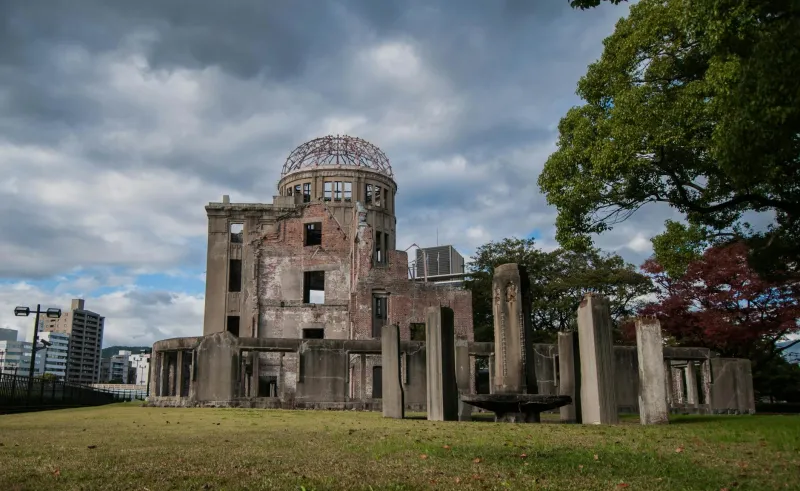
The Business Trip That Defied All Odds
On the morning of August 6, 1945, Tsutomu Yamaguchi was supposed to be heading home. The 29-year-old naval engineer had just finished a three-month assignment in Hiroshima designing oil tankers for Mitsubishi Heavy Industries. His bags were packed, his train ticket purchased, and he was walking to the station with two colleagues when they realized they'd forgotten something back at the shipyard.
That forgotten item — probably just paperwork or a personal belonging — saved and damned Yamaguchi's life in ways that would have been impossible to imagine.
As the three men turned back toward the shipyard, a lone B-29 bomber appeared in the clear morning sky above Hiroshima. At 8:15 AM, the Enola Gay released "Little Boy," the world's first combat atomic weapon.
Ground Zero, Take One
Yamaguchi was roughly two miles from the blast center when the bomb detonated. He later described seeing a brilliant flash "like the sun falling to earth," followed by a wall of scorching heat that knocked him unconscious. When he came to, the world had changed completely.
The blast had burned the left side of his face and arms, burst his eardrums, and temporarily blinded him. But he was alive, which was more than could be said for most people within a three-mile radius of ground zero. The two colleagues who had been walking with him were never found.
Staggering through the apocalyptic landscape that had been downtown Hiroshima, Yamaguchi somehow made his way to an evacuation center. Despite his injuries, he was determined to get home to his wife and infant son in Nagasaki, about 180 miles southwest.
The Journey Between Disasters
The train journey that should have taken a few hours stretched into an entire day and night. Rail lines were destroyed, bridges had collapsed, and the few functioning trains were packed with refugees fleeing the devastation. Yamaguchi, burned and partially deaf, spent nearly 20 hours traveling through a Japan that was trying to comprehend what had just happened.
He arrived in Nagasaki on August 8, exhausted and traumatized but grateful to be reunited with his family. His wife, Hisako, was horrified by his injuries and his account of what he'd witnessed. Like most Japanese civilians, she had never heard the term "atomic bomb" and could barely process his description of a single weapon destroying an entire city.
Yamaguchi's employer, Mitsubishi, had a shipyard in Nagasaki too. Despite his condition, he reported to work on the morning of August 9, determined to tell his supervisors about the devastating new weapon and urge them to prepare for the possibility of another attack.
Lightning Strikes Twice
At 11:02 AM on August 9, as Yamaguchi sat in a Mitsubishi office building describing the Hiroshima bombing to his incredulous boss, he saw another familiar flash outside the window.
"Fat Man," the second atomic bomb, had just detonated over Nagasaki.
This time, Yamaguchi was about two miles from ground zero again — roughly the same distance as in Hiroshima. The blast wave shattered the windows around him and filled the air with debris, but the building's structure held. His previous injuries reopened and began bleeding, but once again, he survived.
The statistical probability of being within the lethal radius of one atomic bomb and surviving was already incredibly small. The odds of surviving two nuclear attacks, in different cities, three days apart, were so astronomically low that no one had ever bothered to calculate them.
The Aftermath of the Impossible
Yamaguchi spent weeks recovering from radiation sickness, burns, and the psychological trauma of experiencing humanity's entry into the nuclear age twice over. His hair fell out, his wounds became infected, and he suffered from fever and nausea for months.
But he lived. And more remarkably, he thrived.
Over the following decades, Yamaguchi returned to work as an engineer, raised three children with his wife, and became an advocate for nuclear disarmament. He rarely spoke publicly about his experiences until late in life, preferring to focus on the future rather than relive those terrifying August days.
A Life Defined by Survival
For most of his life, Yamaguchi's double survival was treated as a curiosity rather than a historically significant event. The Japanese government didn't officially recognize him as a survivor of both bombings until 2009, when he was 93 years old — making him the only person formally acknowledged as a "nijū hibakusha" (double bomb survivor).
By then, Yamaguchi had decided to share his story with the world. He began giving interviews and speeches, not to seek attention for his remarkable survival, but to bear witness to the human cost of nuclear warfare. He wanted people to understand that atomic weapons weren't abstract strategic tools — they were instruments of unimaginable human suffering.
The Weight of Witnessing
"I could have easily died in either bombing," Yamaguchi said in one of his final interviews. "The fact that I survived both means I was meant to tell people about them."
He lived to age 93, dying of stomach cancer in 2010 — 65 years after those two August mornings that should have killed him twice over. His longevity itself seemed to defy the conventional wisdom about radiation exposure, though doctors could never definitively say whether his cancer was related to the bombings.
The Impossibility of It All
Tsutomu Yamaguchi's story challenges our understanding of probability, survival, and human resilience. He was in the wrong place at the wrong time — twice — and somehow turned that cosmic bad luck into a life of purpose and advocacy.
The mathematical odds of his survival were so slim that his story might seem fictional if it weren't so thoroughly documented. But perhaps that's the point: sometimes reality is stranger than any fiction we could imagine, and the most unbelievable stories are the ones that actually happened.
In a world that had just learned to split the atom, Yamaguchi proved that the human spirit was equally impossible to destroy.