
The Woman Who Made Rescuing Look Easy
Imagine being so good at your job that newspapers across the country write about you, the President of the United States visits your workplace, and Congress debates your heroism — but your own employer refuses to put you on the payroll. That was life for Ida Lewis, the lighthouse keeper who saved more lives than any other person in American maritime history, yet spent decades fighting the federal government just to get officially hired.
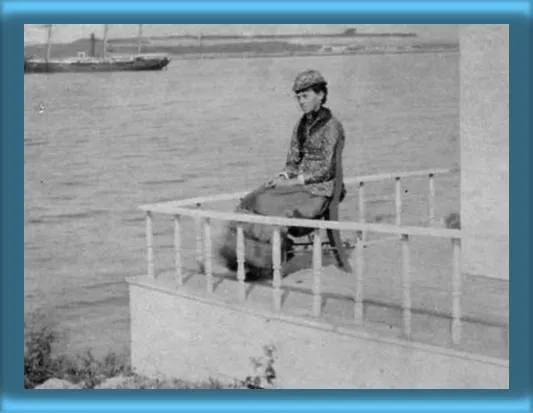 Photo: Ida Lewis, via www.rhodeislandlighthousehistory.info
Between 1857 and 1911, Lewis pulled an estimated 600 people from the churning waters around Lime Rock Lighthouse in Newport, Rhode Island. She performed her first rescue at age 16 and her last at 63, rowing through storms that seasoned sailors wouldn't dare navigate. But here's the kicker: for most of those 54 years, she wasn't technically employed by anyone.
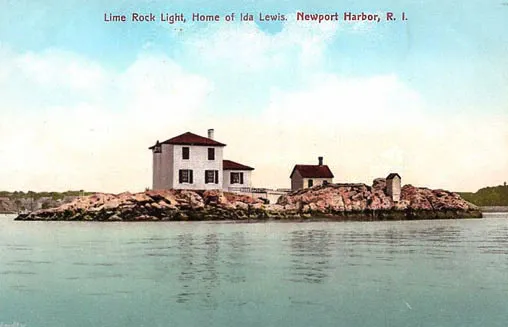 Photo: Lime Rock Lighthouse, via www.rhodeislandlighthousehistory.info
When Your Dad's Job Becomes Your Life's Work
The story begins with a bureaucratic accident. In 1857, Ida's father Hosea Lewis was appointed keeper of Lime Rock Light. The job came with a house on the tiny island and a modest salary to maintain the beacon that guided ships through Newport Harbor's treacherous waters.
Within months, Hosea suffered a stroke that left him unable to perform his duties. Rather than replace him, the Lighthouse Board simply... looked the other way while his teenage daughter took over. Ida began tending the light, maintaining the equipment, and rowing back and forth to the mainland for supplies — all without any official recognition or compensation.
Then the rescues started.
The Rescue That Made Headlines
On March 29, 1869, Ida spotted four young men whose sailboat had capsized in rough seas. Without hesitation, she launched her small rowboat into waves that were crashing over nearby rocks. Fighting against wind and current, she managed to pull all four men to safety.
Word of the rescue spread quickly through Newport's tight-knit community, then to newspapers across New England. Suddenly, everyone wanted to know about the fearless woman who lived on a rock in the harbor and saved drowning sailors like it was just another Tuesday.
But when reporters asked about her official title, things got awkward. Technically, her father was still the lighthouse keeper. Ida was just... helping out. For twelve years.
America's Sweetheart Lives on a Rock
The 1869 rescue transformed Ida Lewis into a national celebrity. Harper's Weekly featured her on their cover. Songwriters penned ballads about her bravery. Tourists flocked to Newport hoping to catch a glimpse of the "Grace Darling of America" (referencing a famous British lighthouse keeper's daughter).
President Ulysses S. Grant himself visited Lime Rock in 1869, shaking hands with the woman who had captured the nation's imagination. Congress passed a resolution praising her "unselfish devotion to humanity." She received gold medals, a new boat (named "Rescue"), and marriage proposals from admirers across the country.
 Photo: Ulysses S. Grant, via cdn.history.com
Yet the Lighthouse Board still wouldn't officially hire her.
The Bureaucrats Finally Blink
It took until 1879 — twenty-two years after she started doing the job — for the government to finally acknowledge reality. When Hosea Lewis died that year, officials faced an uncomfortable choice: find a new keeper or admit they'd been relying on an "unofficial" employee for over two decades.
They chose the path of least resistance and formally appointed Ida as keeper of Lime Rock Light. Her annual salary? $750, the highest ever paid to a lighthouse keeper at that time — a tacit admission that she'd been drastically underpaid (or rather, unpaid) for years.
The Rescues Never Stopped
Official employment didn't slow Ida down. She continued rowing out into dangerous waters well into her sixties, guided by an almost supernatural ability to spot trouble before anyone else. Sailors claimed she could sense a vessel in distress from miles away, often appearing seemingly out of nowhere just when hope was fading.
Her most remarkable rescue came in 1881, when she was 39 years old. During a February blizzard, she spotted a man clinging to an overturned boat nearly half a mile from shore. The seas were so rough that the Coast Guard couldn't launch their boats. Ida rowed out alone, battling ice and waves for over an hour to reach the sailor and bring him back alive.
The Price of Being Indispensable
Ida Lewis's story reveals an uncomfortable truth about 19th-century America: sometimes being exceptional wasn't enough if you were the wrong gender. The government was happy to benefit from her heroism and bask in the reflected glory of her fame, but actually putting her on the books required overcoming decades of institutional inertia.
When she finally retired in 1911 at age 69, Ida had become the longest-serving lighthouse keeper in American history. She died just months later, still living in the house on Lime Rock where she'd spent nearly her entire adult life.
The Ultimate Recognition
Today, the Coast Guard's highest honor for maritime lifesaving is the Ida Lewis Medal. The lighthouse where she worked has been renamed the Ida Lewis Yacht Club. Her story is taught in Coast Guard training as an example of courage and dedication.
But perhaps the strangest tribute is this: in an age when lighthouse keeping was considered one of the most dangerous and demanding jobs in America, Ida Lewis proved that the best person for the job might be someone the system never thought to hire in the first place. She saved 600 lives not because she was officially qualified, but because when people were drowning, she rowed out to get them.
Sometimes the most important work happens in the gaps where bureaucracy fears to tread.